From observed biological responses to structured-light science
Gunalight was not created as a conventional red-light, near-infrared, laser or standard photobiomodulation device.
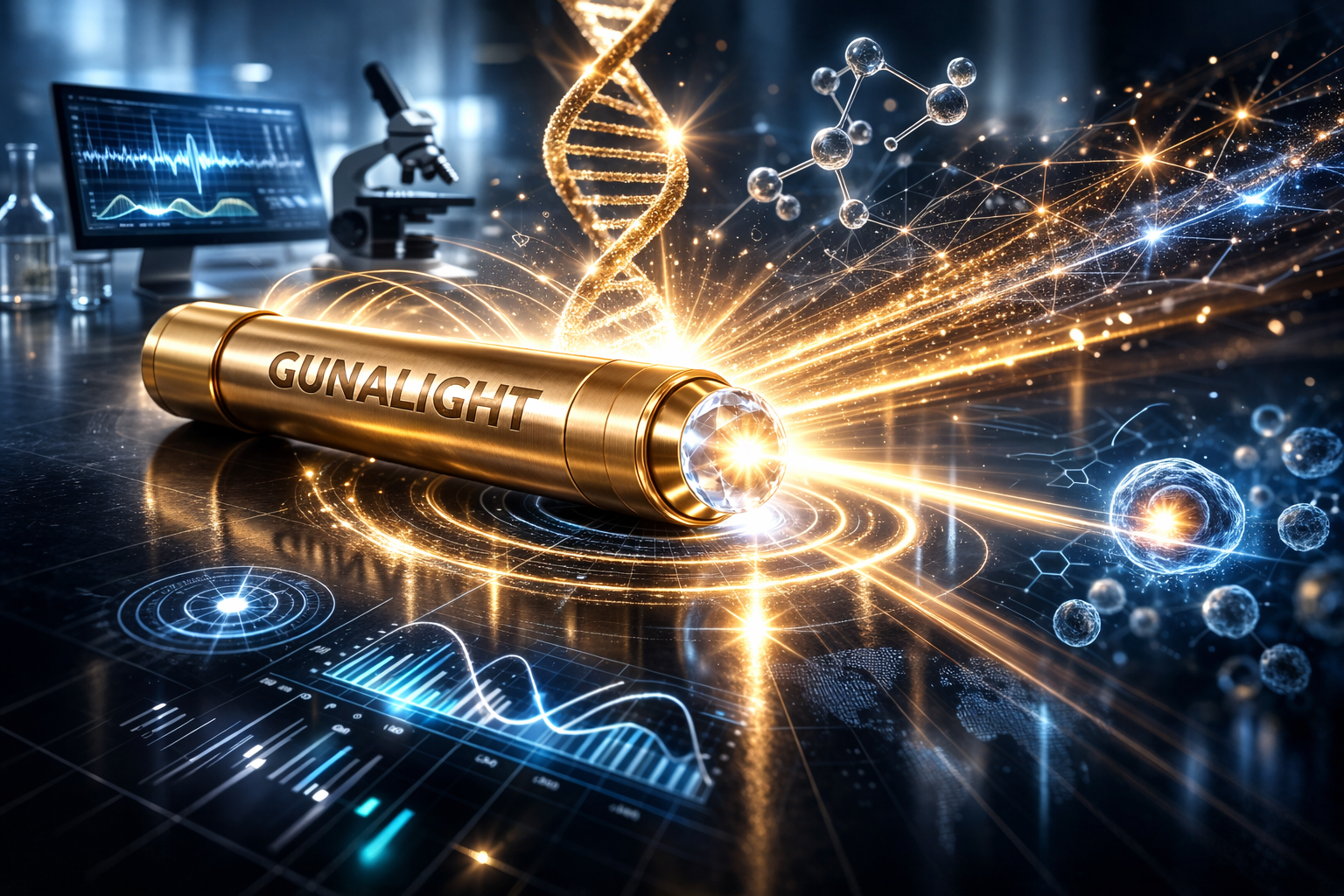
It is a patented structured-light technology based on a different optical principle. Broadband LED light is transmitted through a natural spherical quartz crystal held inside a precision optical configuration. The emitted light is not simply the original LED output. The interaction between light, crystal, material and geometry produces a distinct structured-light output.
The research case for Gunalight is built on four connected layers: long-term real-world observations by Akulight since 2016, independent optical measurements performed at NTNU in Norway in 2019, U.S. practitioner-market introduction through Miridia Technology from September 2023, and recent ATP/ROS results confirming a non-conventional biological profile.
Together, these layers point to the same conclusion: Gunalight should be evaluated as a distinct optical-biological technology platform, not as another light-therapy product.
The central research question is not whether light can affect biology. That is already well established. The question is why this specific structured-light output has been associated with repeated regulation-related responses since 2016, why its measured optical profile differs from known light-therapy categories, and how this platform should now be verified and developed at scientific and commercial scale.
Real-world use came first
In science, practice often comes before theory. A phenomenon is first observed. Then it is measured. Then it is tested. Only later is it fully explained. Gunalight is moving through that process now.
The practical observations created the original question: why would a small handheld light device be associated with regulation-related responses broader than what would normally be expected from a simple light source?
Gunalight did not begin as a theoretical laboratory concept.
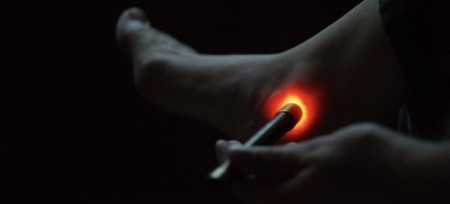
Since 2016, Gunalight has been used in real-world settings by Akulight, private users and selected practitioners. Across years of practical use, Akulight has observed repeated regulation-related responses in areas connected to circulation, lymphatic flow, inflammation-related patterns, autonomic balance, tissue recovery, neuromuscular function, skin and connective-tissue response.
These observations came before the measurements. That matters.
The NTNU measurements helped explain why the output is physically different. The ATP/ROS results then added a biological layer, showing that Gunalight does not behave like a conventional ATP-driven photobiomodulation device and does not produce the ROS increase one would normally watch for with biologically active lower-wavelength exposure.
The measurements did not create the phenomenon. They helped describe it. The ATP/ROS testing did not create the biological question. It made the distinction sharper.
The practical experience remains central because it is the reason the technology matters.
U.S. practitioner-market introduction
The U.S. market introduction began later.
From September 2023, Gunalight was commercially introduced in the United States through Miridia Technology, an established practitioner-focused distribution and education channel.
This gave the technology a professional market entry outside Norway, with educational infrastructure, structured application protocols, videos and public practitioner-facing material already in place.
These U.S. materials are separate from Akulight’s own long-term observations, but they show that the technology has entered a professional application environment outside Norway.
This is important because Gunalight is not only a laboratory concept or an early-stage prototype. It is a patented structured-light technology that has already been manufactured, commercialized, introduced internationally and used in real-world application environments.
Independent optical measurements
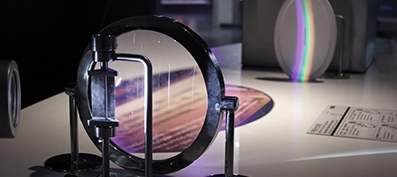
In 2019, independent optical measurements performed at NTNU in Norway showed that the light emitted from Gunalight after transmission through the crystal had a broad measured spectrum of approximately 350–850 nm.
The measurements also showed a modulation pattern in the approximate range of 167,000–520,000 Hz.
This combination is central to the scientific and strategic significance of Gunalight.
We have not identified any comparable technology combining broadband 350–850 nm light, natural crystal-based optical structuring and a measured modulation profile in the 167,000–520,000 Hz range in available scientific literature, patent literature, expert discussions or targeted searches.
This measured optical-energy profile separates Gunalight from conventional light-therapy categories.
Most light-based devices are defined primarily by wavelength, power, coherence, dose and exposure time. Gunalight adds another dimension: the structuring of broadband light through a natural crystal-optical configuration, creating a measured output where spectrum, modulation, intensity, material interaction and geometry operate together.
That makes the technology fundamentally different from devices that primarily rely on red light, near-infrared output, laser coherence, selected wavelength bands or high optical intensity.
The significance of the 350 nm region
The measured spectrum extending down to approximately 350 nm is one of the most important parts of the research case.
This region is biologically active and cannot be treated as irrelevant. Light in and near this range would normally require careful attention to oxidative stress, mitochondrial response and ROS formation, depending on dose, exposure conditions and biological model.
That is exactly why ATP/ROS testing became important.
If Gunalight were simply a broad-spectrum optical exposure with biologically active lower wavelengths, one would normally watch for signs of increased oxidative stress. If Gunalight were simply another standard photobiomodulation device, one would expect a more conventional ATP-related profile.
The result did not fit either simple category.
Gunalight did not increase total ROS or mitochondrial ROS under the tested conditions, despite the measured spectrum extending down to approximately 350 nm.
This is a major distinction. It shows that the lower-wavelength part of the measured output does not behave, under the tested conditions, like a conventional stressful optical exposure.
That directly supports the central position of Gunalight: the technology is not simply emitting light. It is producing a structured optical output with a biological profile that differs from standard expectations.
ATP/ROS testing
ATP and ROS were selected because they are central markers in light-response biology.
ATP is closely connected to cellular energy status and mitochondrial function. ROS, or reactive oxygen species, is closely connected to oxidative stress, mitochondrial response and cellular signalling.
In conventional photobiomodulation, red and near-infrared wavelengths are often discussed in relation to mitochondrial activity, cytochrome c oxidase, ATP production and related energy mechanisms.
Gunalight has now been tested against ATP and ROS markers.
The results are important because they do not place Gunalight inside the standard light-therapy model.
Gunalight did not show a conventional ATP-driven photobiomodulation profile under the tested conditions. At the same time, Gunalight did not increase total ROS or mitochondrial ROS, despite the measured optical spectrum extending down to approximately 350 nm.
If the device were merely acting as a conventional red-light or near-infrared PBM system, the ATP profile would be expected to align more clearly with established PBM assumptions. If the device were merely acting as a stressful broad-spectrum optical exposure, the ROS profile would be expected to move in that direction.
It did neither.
The result supports the conclusion that Gunalight should be evaluated as a separate optical-biological platform.
The ATP/ROS findings do not reduce the significance of Gunalight. They sharpen it. They show that Gunalight is not simply reproducing known light-therapy mechanisms. The technology is doing something different.
The convergence
The strongest research point is not one measurement, one test or one observation.
It is the convergence between them.
Years of real-world use have shown repeated regulation-related responses. NTNU measurements showed an unusual structured-light profile: approximately 350–850 nm combined with approximately 167,000–520,000 Hz modulation after transmission through the crystal configuration.
The U.S. introduction through Miridia Technology from September 2023 shows that the technology has also entered a professional practitioner-focused market environment outside Norway.
ATP/ROS testing adds a biological layer that supports the same conclusion: Gunalight does not behave like standard ATP-driven PBM and does not create the ROS increase one would normally watch for with biologically active lower-wavelength exposure.
These layers point in the same direction.
Practical use shows biological relevance. Optical measurements show physical distinction. U.S. practitioner-market introduction shows early professional market exposure. ATP/ROS testing shows biological distinction from conventional light-therapy assumptions.
A measurement alone can be interesting. A user observation alone can be dismissed as anecdotal. A market introduction alone can be interpreted as commercial activity only. A cellular test alone can be interpreted narrowly.
But when years of practical observation, independent physical measurements, international practitioner-market introduction and biological testing all point toward the same conclusion, the technology can no longer be evaluated as an ordinary light-therapy product.
It has to be evaluated as a distinct optical-biological platform.
Not standard PBM
Gunalight should not be evaluated as standard photobiomodulation.
It is not red light. It is not NIR. It is not laser. It is not a higher-powered version of an existing light device.
It is a patented structured-light technology built around a natural crystal-optical configuration that creates a distinct measured output.
Standard photobiomodulation is usually discussed through wavelength, dose, power density, exposure time and mitochondrial light absorption.
Gunalight requires a broader model.
The relevant question is not only which wavelengths are present, but what happens when broadband light passes through a natural spherical quartz crystal inside a patented optical configuration and exits as a measured structured-light output with a modulation profile in the 167,000–520,000 Hz range.
That is why Gunalight belongs in its own category.
Why this matters
Light is one of biology’s most fundamental environmental signals.
Every living system is shaped by light, rhythm, energy transfer and electromagnetic interaction. Modern light-based technologies have already shown that specific wavelengths and exposure parameters can produce biological effects.
Gunalight moves the question further.
The technology is not based on the idea that more light is always better, or that one selected wavelength is the whole answer.
Instead, Gunalight uses a patented crystal-optical configuration to produce a structured output where spectrum, modulation, intensity, material interaction and geometry are all part of the final emitted energy.
This gives Gunalight a different scientific starting point from ordinary light-therapy products.
It also gives the platform broader strategic relevance. If a structured-light output can produce regulation-related biological responses across several physiological patterns, then the opportunity is not limited to one device, one protocol or one indication.
The opportunity is a new category of non-invasive biological regulation.
Research direction
The next stage of research should be performed at a level that matches the significance of the platform.
The priority is not to force Gunalight into existing light-therapy assumptions. The priority is to define the biological effects of this specific structured-light output.
Important research areas include cellular energy response, oxidative stress and ROS balance, mitochondrial function, inflammatory signalling, microcirculation, lymphatic flow, autonomic nervous system response, tissue repair and recovery markers, neuromuscular regulation, skin and connective-tissue response, dose, timing and exposure parameters, comparison against red light, NIR, laser, standard PBM and sham exposure, selected veterinary and animal-use research, and future applications in biological, agricultural, material or industrial settings.
These areas are relevant because they reflect both the biological patterns observed in practical use and the mechanisms most likely to be affected by a non-invasive optical-biological regulation technology.
The purpose of further research is not to prove that light can affect biology. That is already known.
The purpose is to define how Gunalight’s structured-light output interacts with biological systems, how the responses can be measured, which exposure parameters matter most, and how the platform can be developed at scientific, regulatory and commercial scale.
A platform technology
Gunalight is currently commercialized as a handheld device, but the underlying principle is broader than one product.
The device is the first commercial expression of the principle. The principle itself is the structured optical-biological interaction created when broadband light is transmitted through a patented natural crystal-optical configuration.
New ways of structuring, transmitting or applying energy often create applications beyond the first intended use. Technologies that begin in one field can later prove relevant in adjacent or entirely different sectors once the underlying physical principle is better understood.
Gunalight should therefore not be assessed only as a consumer health device or a practitioner tool.
It should be assessed as a structured-light platform.
The most immediate relevance is in non-invasive biological regulation, including cellular energy balance, oxidative-stress response, inflammation-related response patterns, microcirculation, lymphatic flow, autonomic balance, tissue recovery, neuromuscular regulation, skin and connective-tissue response and longevity-oriented consumer health.
Over time, the same structured-light principle may also prove relevant in other biological, environmental, agricultural, material or industrial contexts where controlled light interaction, energy transfer or biological regulation is important.
That broader optionality is strategically important.
The current product demonstrates the principle. The patent portfolio protects the configuration. The optical measurements describe the output. The ATP/ROS results separate the biological profile from conventional light therapy.
Strategic significance
Gunalight should be understood as more than a device.
It is a patented optical configuration that produces a measured structured-light output and has been associated with repeated biological regulation patterns in real-world use.
That combination is rare.
The strategic significance is not limited to the current handheld product. The current product proves that the principle can be commercialized. The larger opportunity is to understand, protect, develop and scale the structured-light platform itself.
From September 2023, Gunalight was introduced into the United States through Miridia Technology, an established practitioner-focused distribution and education channel. This created professional market exposure outside Norway, with educational infrastructure, structured application protocols, videos and public practitioner-facing material already in place.
Scientifically, Gunalight opens a research path into how structured broadband light, natural crystal optics, modulation and biological regulation interact.
Commercially, the platform creates optionality across consumer health, practitioner markets, medtech, longevity, wellness technology, selected veterinary applications, biological research and future industrial or agricultural light-interaction fields.
Strategically, the value lies in defining and controlling a category before it becomes obvious.
Current position
Gunalight is a patented structured-light technology from Norway.
It has several years of real-world use behind it. It has been independently measured optically. It was introduced into the U.S. practitioner market through Miridia Technology from September 2023. It has a measured optical profile we have not identified in comparable technologies. It has now been tested against ATP and ROS markers.
The results support the same conclusion: Gunalight is not standard PBM, not conventional red light, not NIR and not laser.
It is a distinct optical-biological platform.
The next stage requires scientific capacity, development resources, regulatory experience and global reach to verify, develop and commercialize the technology at the level it deserves.
Available studies and reports
The following materials provide additional context for Gunalight’s optical measurements, practical observations and scientific background.
NTNU optical measurements, 2019
Health Optimizing report, Bergen, 2021
Dr. Mackenzie survey, 2024
Dr. Gundersen examinations, 2017–2018
Photobiomodulation context and related scientific background